
If you own a house with squatters california law gives you two lawful routes to get them out: a trespass report to police, or a court-ordered eviction carried out by the sheriff. You can still sell the house in the meantime, but the occupants affect your disclosures, your buyer pool and your timeline.
Do squatters have rights in California?
Not automatically. “Squatter’s rights” usually means adverse possession, which is hard to prove: the occupant must show five years of continuous occupation and timely payment of property taxes. Occupants who were tenants or had permission are a different situation and generally call for the court process.
Under Code of Civil Procedure § 325(b), a claimant must show the land was occupied and claimed continuously for five years, and that they timely paid all taxes levied and assessed during that period. Payment has to be established by certified records of the county tax collector, and a Court of Appeal decision concluded that a lump-sum payment of delinquent taxes does not count as timely payment. The claimant also carries the burden of proving every element, including actual occupation that gives the owner reasonable notice.
In plain terms, someone who recently moved into an empty house is unlikely to meet that standard. That does not mean they can be removed on the owner’s say-so, though. Removal still runs through police or the courts.
Squatter or tenant? The label matters
Someone who ever had a lease, paid rent or had the owner’s permission may be treated as a tenant or licensee, and that changes the notice and court steps. A bill that did not pass, SB 448, would have excluded tenants, holdover tenants, former tenants in an active dispute and people with a bona fide claim of tenancy or title from the removal process it proposed. That carve-out is a good hint at who likely needs a court case.
Our guide to evicting a tenant before selling a rental walks through that process, and our page on selling when a tenant refuses to leave covers the sale side. For occupants with some claim to be there, our page on cash for keys in California explains a negotiated move-out.
What has and hasn’t changed in the law
SB 448 would have let owners serve a demand to vacate and then ask police to remove trespassers from residential property. The Legislature’s records list it as an inactive bill that died in the Senate Appropriations committee. AB 897, the “Remove Illegal Squatters from Private Property Act,” would create a crime of unlawful squatting, so check its current status before relying on it. AB 2943 is often cited as a squatter law, but it is a shoplifting bill.
How can you legally remove squatters in California?
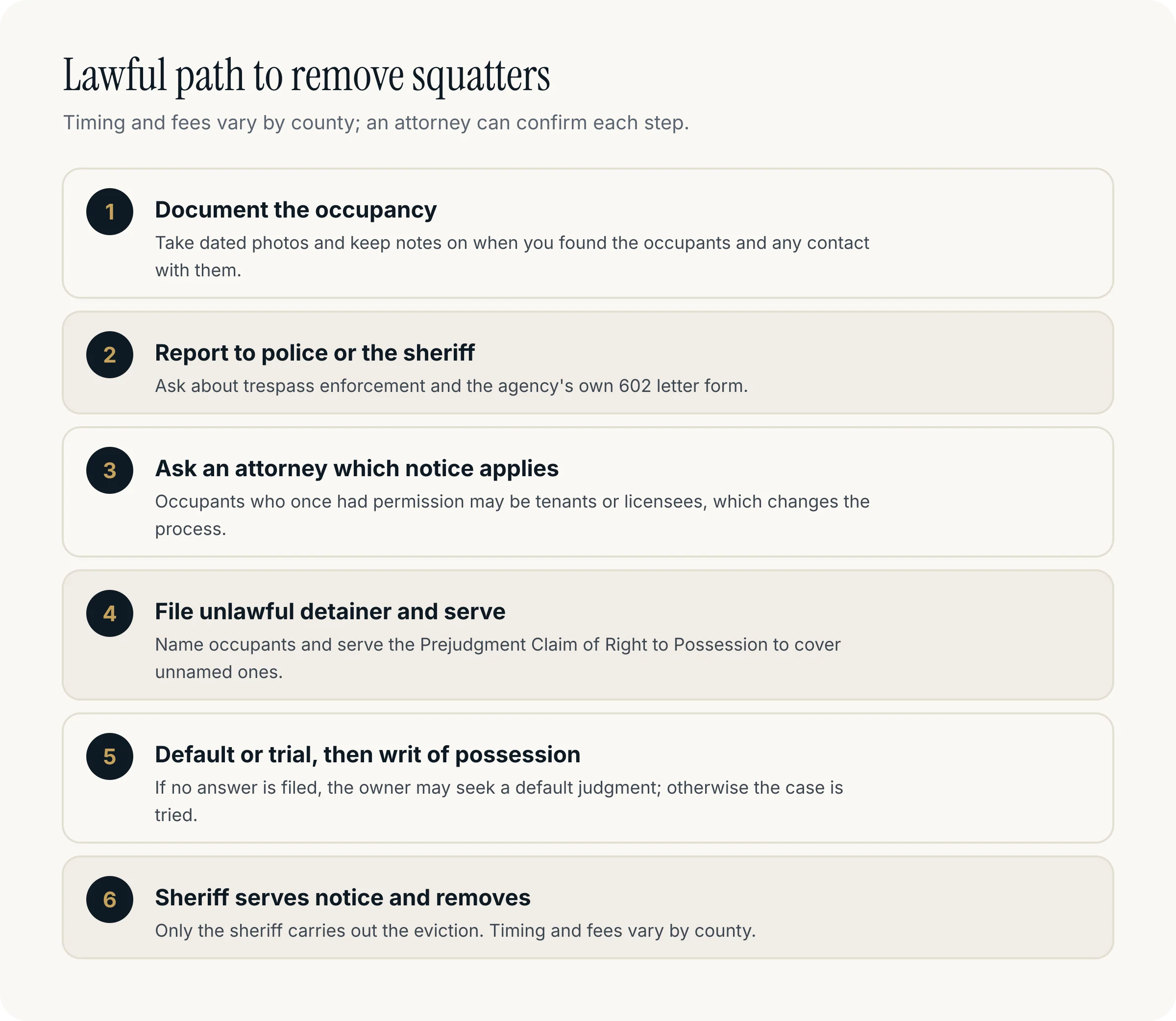
Through law enforcement or the courts, not self-help. Police can act on trespass when the owner asks, and a standing request called a 602 letter can extend that authority. For occupants with any claim to be there, a court order enforced by the sheriff is the formal route, because only a sheriff can carry out an eviction.
Police reports and 602 letters
Refusing to leave property that belongs to or is lawfully occupied by another, when asked by a peace officer acting for the owner, is misdemeanor trespass under Penal Code § 602(o). Section 602(m) separately covers entering and occupying structures without the owner’s consent. Police act on a request from the owner.
A “602 letter” is a request for law enforcement assistance that authorizes officers to enforce trespass laws on the property in the owner’s absence. It is generally used for property closed to the public and posted as closed. The form and process differ by agency, and a Senate analysis noted that some agencies have very informal 602-letter processes, so contact the local police department or sheriff for its form. Some requests have been limited to 30 days, and SB 602 proposed extending certain requests to 12 months, so ask the agency which limit applies now.
One detail matters for a sale: the request expires upon transfer of ownership or a change in the person in lawful possession. A buyer would need to file their own request.
Court eviction (unlawful detainer)
The landlord must get a court order for the sheriff to evict. The statute covers people who occupy as a servant, employee, agent or licensee, and cases where that relationship was lawfully terminated or the agreed time for occupancy expired. Which notice applies to someone who never had permission is a question for an attorney.
Statewide court guidance says a person who is served has 10 court days to file an Answer, not counting weekends or court holidays. Some county pages differ: Yuba County says five days, while Fresno County says ten. Cases must be set for trial no later than 20 days after the first request. If the occupant does not answer, the owner may seek a default judgment using forms such as the Request for Entry of Default (CIV-100), Judgment (UD-110) and Writ of Possession (EJ-130).
After a writ is issued, the sheriff serves a Notice to Vacate, and the occupant then has five days to move before the sheriff physically removes them. Madera County’s packet describes at least five court days. Timing and fees vary by county sheriff.
The common pitfall is unnamed occupants. Unless the Prejudgment Claim of Right to Possession (CP10.5) was served, an occupant not named in the judgment who was there when the case was filed can file a claim of right to possession. Presenting it to the levying officer stops the eviction.
Can you sell a house with squatters in it?
In principle yes, but occupants make a sale harder. Owners generally choose between clearing the occupants first, which opens up more options, or selling to a buyer willing to take the house as it is. Each path trades time, effort and price differently.
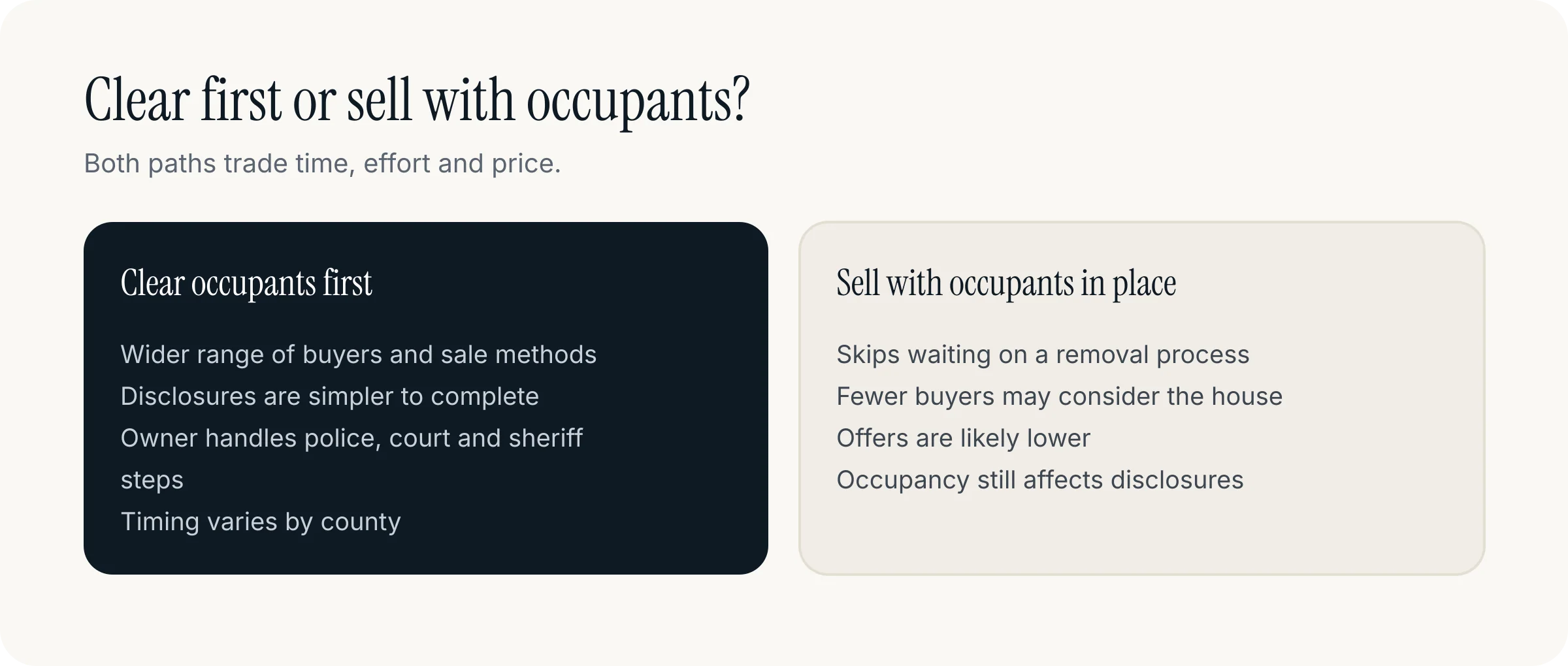
| Approach | Upside | Downside |
|---|---|---|
| Remove occupants, then list with an agent | Widest buyer pool; a fully prepared listing often brings more | Slowest; legal steps, cleanup and showings come first |
| Remove occupants, then sell for cash | Faster, simpler sale of an empty house | Usually less than a fully prepared listing |
| Sell with occupants in place | Skips the wait for a removal process | Fewer buyers may consider it, and offers are likely lower |
A cash sale is usually faster and simpler, but it often brings less than a fully prepared listing. A sale also does not resolve legal obligations by itself, so keep any court, lender or tax deadlines in view and talk to an attorney. Sell Quick California only makes cash offers; we don’t list houses.
Once the occupants are gone, a vacant house is much simpler to sell, and our guide to selling a vacant house fast in California covers that stage. Owners are often left with damage and leftover belongings after a removal. We buy houses as-is; the seller makes no repairs. Sellers can leave trash and personal items behind.
If the owner owes more than the house is worth, a cash sale usually won’t work. When a seller owes more than the house is worth, or a reverse mortgage is close to the value, a short sale or an experienced listing agent is the better path; our sister company Investly handles those.
What do you have to disclose when selling?
Sellers of one-to-four unit homes generally must deliver a Transfer Disclosure Statement, and sellers and agents must disclose material facts. Whether unauthorized occupants have to be named is a question for a real estate attorney, so ask before you sign anything.
Civil Code § 1102.3 requires a seller of one-to-four residential dwelling units to deliver the statement to prospective buyers, as the Department of Real Estate’s reference book explains. It covers matters within the personal knowledge of the seller and the agent, and matters based on a reasonably diligent inspection. The statutory form includes a line indicating whether the seller is or is not occupying the property.
Sellers are expected to disclose “material” facts, meaning facts important to the buyer’s decision, and agents must disclose all material facts affecting value, desirability and intended use.
Timing matters. If a disclosure is delivered after an offer, the buyer has three days after in-person delivery, or five days after mailing, to terminate. A sale is not invalidated solely for non-compliance, but a person who willfully or negligently fails to perform the disclosure duties is liable for actual damages.
What to do next if squatters are in your house
Document the situation, contact the police or sheriff, and get advice from a real estate attorney before taking any step that could create legal risk. Then decide whether to clear the house first or explore an as-is sale.
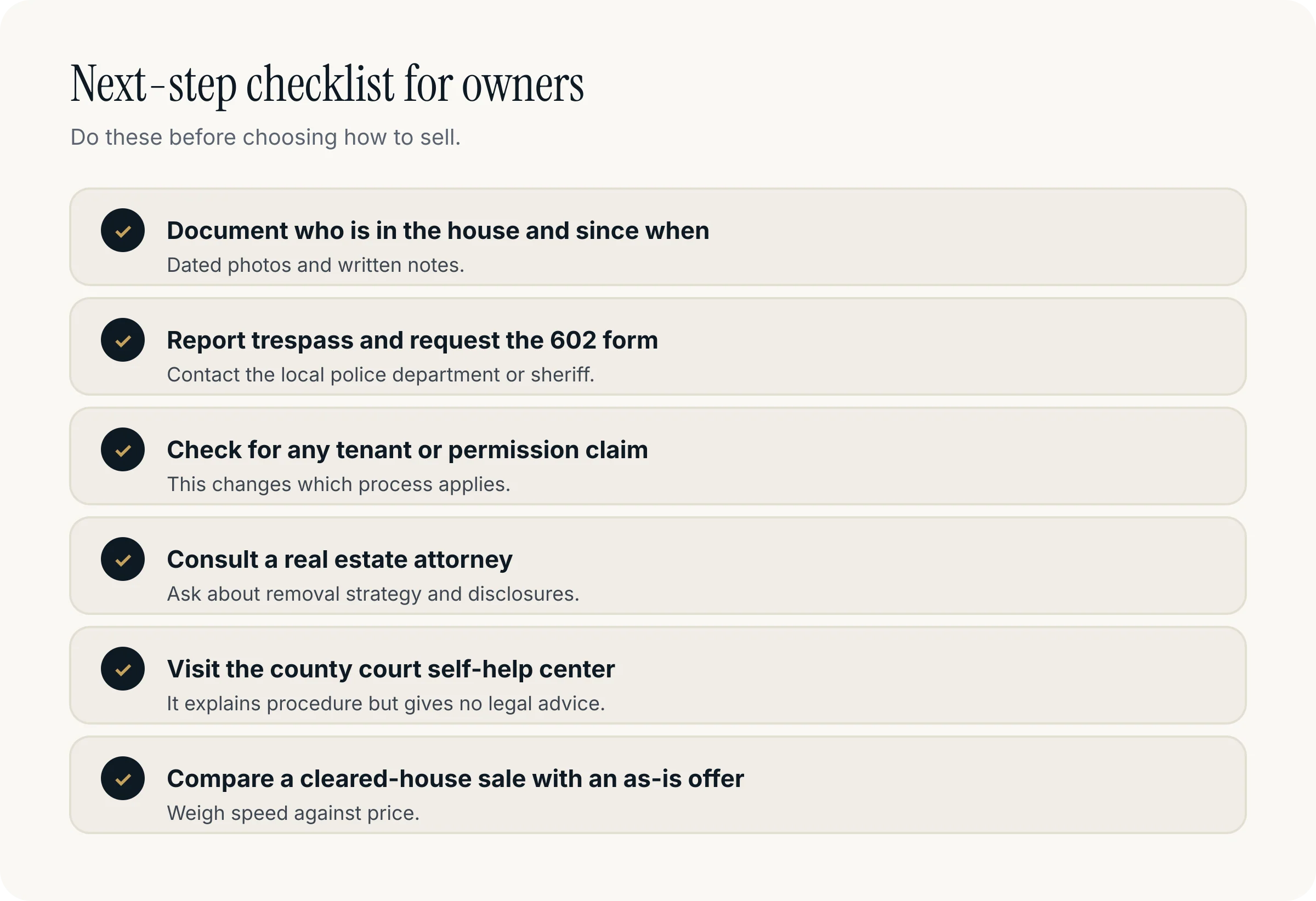
- Take dated photos and write down when and how you found the occupants.
- Report the trespass and ask the local agency for its 602 letter form.
- Check whether anyone could claim to be a tenant or to have had permission.
- Talk to a California real estate attorney about removal and disclosure, including questions like changing locks or handling belongings.
- Contact the superior court self-help center in the county where the house sits. Self-help centers explain procedure but cannot give legal advice or represent you.
- Compare selling after removal with an as-is cash offer, including the tradeoff in price.
This article is general information, not legal advice. Talk to a California attorney about your situation.
Owners with an occupied house can describe the situation, including who is living there, and see whether a cash offer is possible. We make a cash offer within 24 hours. We pay all closing costs, including escrow, title and transfer fees, and charge no commission. Call (925) 854-5040 or tell us about the house through our offer form or contact page, and we’ll send a no-obligation cash offer.