FIRPTA withholding means that when a foreign person sells U.S. real estate, the buyer is usually required to hold back part of the price and send it to the IRS. For a foreign owner selling a California house, that is only one layer, because California has its own separate withholding rules, and both are prepayments of tax rather than extra taxes.
Who has to withhold under FIRPTA?
In most cases, the buyer (the “transferee”) is the withholding agent and must find out whether the seller is a foreign person. If the seller is foreign and the buyer fails to withhold, the buyer may be held liable for the tax, according to the IRS FIRPTA withholding page.
That is why escrow asks every seller, foreign or not, to sign a statement about their tax status. The buyer carries the legal risk, so buyers and escrow officers tend to be careful about it.
A few details trip up foreign owners:
- Co-owners. When some sellers are foreign and some are not, the amount realized is allocated among sellers by capital contribution, with spouses treated as contributing equally. Withholding applies to the total allocated to the foreign sellers.
- Entities. A disregarded entity cannot certify as the seller. Its owner is treated as the seller and must provide the certificate.
- “Amount realized.” This is the cash paid, plus the fair market value of any other property transferred, plus debt the buyer assumes. It is not just the check you receive.
How much FIRPTA withholding applies to a house sale?
The IRS sets the rate based on the price and on what the buyer plans to do with the property. A reduced 10% rate applies when the buyer acquires the property to use as a residence, and the rate is 15% when the amount realized is above $1,000,000.
| Situation | Federal withholding |
|---|---|
| Buyer acquires the property for use as a residence | Reduced rate of 10% |
| Amount realized is above $1,000,000 | 15% |
| Individual buyers acquire it as a residence and the amount realized is $300,000 or less | No withholding required |
The residence exception has strings attached. The buyer or a family member must have definite plans to live in the home for at least 50% of the days the property is used. It also does not apply if the actual buyer is not an individual, even if the property is acquired for an individual.
The $300,000 test looks at the whole price. A foreign seller is not exempt when the buyer intends to live there and the total amount realized is over $300,000, even if each seller’s share is $300,000 or less. If the buyer relies on the exception but does not actually live there as planned, the buyer can be liable for failing to withhold, provided the foreign seller did not pay the full U.S. tax due.
How can a seller reduce or avoid FIRPTA withholding?
There are three main routes: prove the seller is not a foreign person, qualify for the residence exception, or ask the IRS for a withholding certificate that reduces or eliminates the amount. Which one fits depends on who the seller is and who the buyer is.
Certification of non-foreign status
Generally, no withholding is required if the buyer receives a signed certification, under penalties of perjury, stating the seller is not a foreign person, with the seller’s name, address and taxpayer identification number. A valid Form W-9 counts. The buyer keeps it for 5 years after the year of transfer. This is the usual path for U.S. citizens and residents who live abroad, since FIRPTA turns on foreign-person status.
A withholding certificate from the IRS
Form 8288-B is used to apply for a withholding certificate that reduces or eliminates withholding, for example when the seller claims a nonrecognition rule or exemption. It can also be used when the seller’s maximum tax liability is less than the tax otherwise withheld. Either the buyer or the seller can file it, and applications go to the Internal Revenue Service, P.O. Box 409101, Ogden, UT 84409.
Three cautions apply:
- The buyer must still withhold even if an application was submitted by the transfer date, so filing does not automatically free up your money at closing.
- If the main purpose of applying is to delay paying the IRS, the buyer can face interest and penalties.
- The IRS generally denies an ITIN application filed before a binding sale contract exists, so plan the taxpayer ID early in the process.
If the seller’s taxpayer ID is missing, the buyer must still report and pay the tax withheld, but the seller cannot get credit or a refund on a Form 8288-A that lacks the seller’s identifying number.
How is California withholding different from FIRPTA?
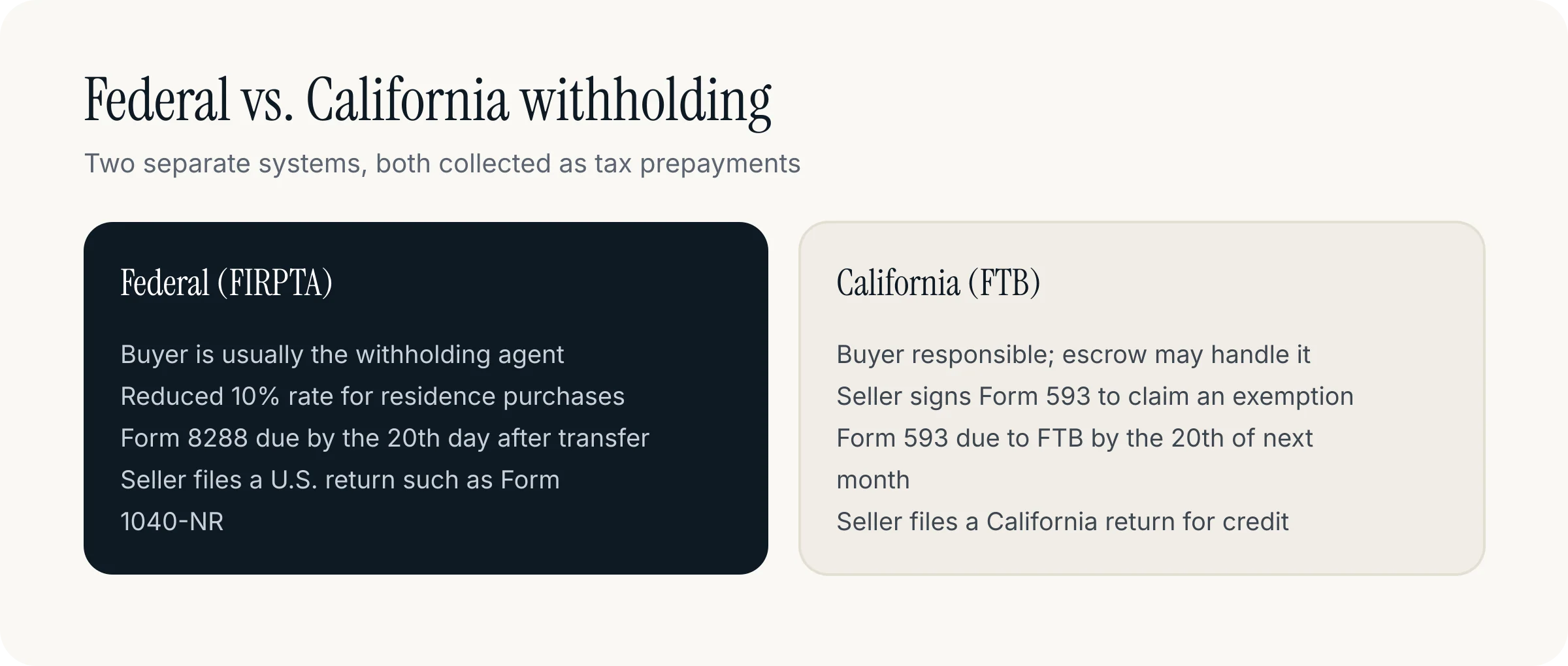
California withholding is a separate requirement and applies on top of any federal amount. Under Revenue and Taxation Code section 18662(e), it covers California residents, nonresident individuals and non-California business entities unless an exception is met, per FTB Publication 1016.
This is the part people searching for “firpta california” often miss. A foreign seller who qualifies for no federal withholding can still face the state’s version.
- Who handles it. The buyer is responsible, but the real estate escrow person may do it on the buyer’s behalf.
- What it is. It is a prepayment of income tax on the gain, not an additional tax. The default is a percentage of the sales price, and individuals can elect an alternative calculation based on the gain.
- How to claim an exemption. The seller signs Form 593 under penalty of perjury and gives it, with a valid taxpayer ID, to the buyer or escrow before closing. Without it, withholding is required.
- Possible exemptions. One is for a principal residence, based on use during the five-year period before the sale. Another is for a seller with a loss or zero gain for California tax purposes.
- No tax ID. Withholding is still required if the seller provides no taxpayer ID.
A seller who knowingly signs a false exemption certificate faces a penalty of the greater of $1,000 or 20% of the required withholding. An owner living abroad should confirm with a tax professional whether the principal-residence exemption applies to a home they no longer occupy. Our guide to California capital gains tax on selling a house covers how the underlying gain is taxed.
What happens after closing?
The money withheld is reported and paid to the IRS and the Franchise Tax Board shortly after closing, and the seller then files tax returns to claim credit. Withholding is a prepayment, so the final bill can be higher or lower than what was withheld.
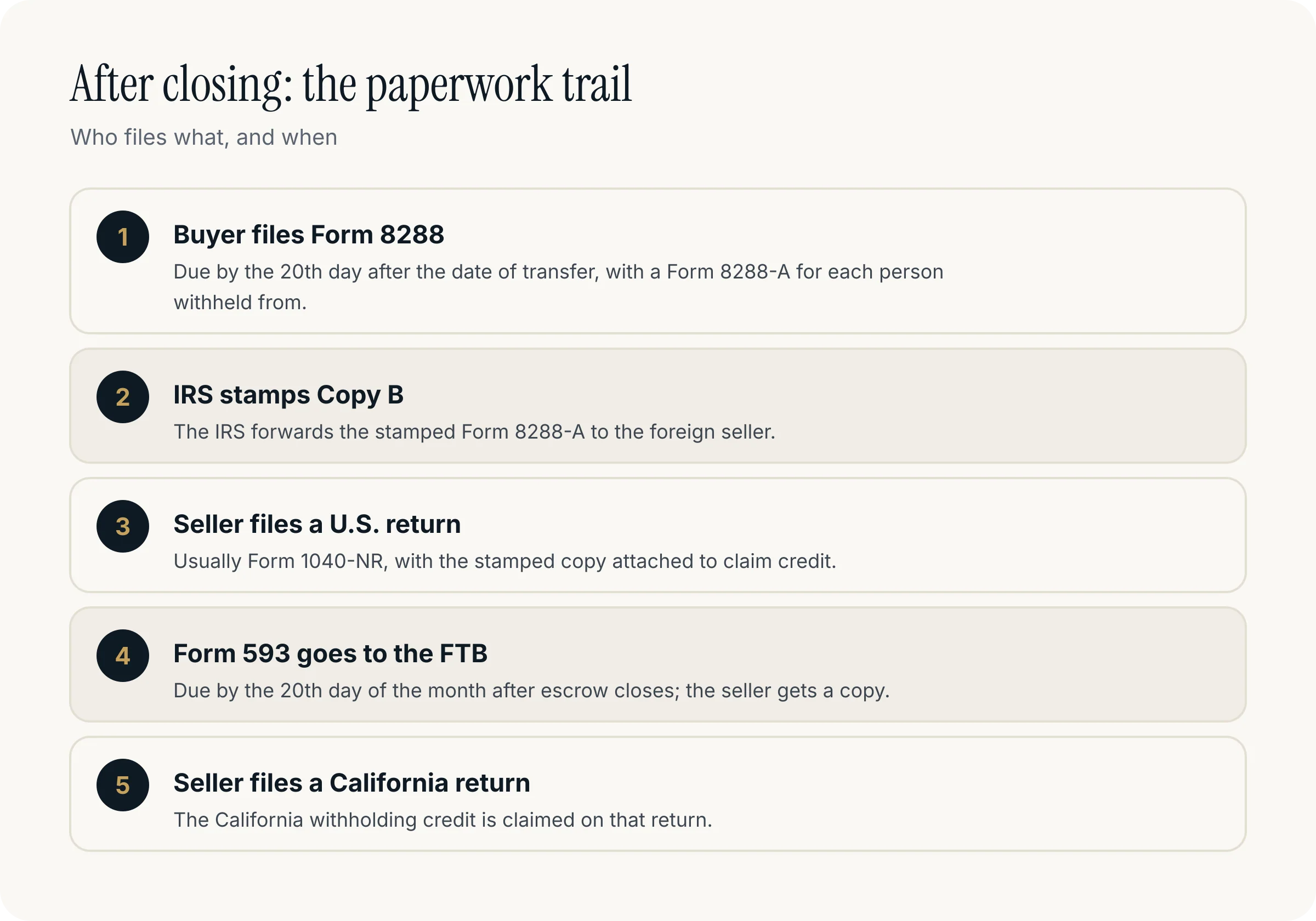
- Federal filing. The buyer files Form 8288 by the 20th day after the date of transfer, and there is no official extension form. The buyer prepares a Form 8288-A for each person withheld from.
- IRS stamp. The IRS stamps Copy B of each Form 8288-A and forwards it to the foreign seller.
- Federal return. The seller generally attaches the stamped copy to a U.S. return such as Form 1040-NR. The seller must file a U.S. return to report the sale.
- California filing. Form 593 goes to the FTB by the 20th day of the month after escrow closes. Payment (Form 593-V) follows the same timeline, and the seller gets a copy by that date.
- California return. To claim the California credit, the seller must file a California tax return. After escrow closes, withheld amounts can be recovered only as a credit on that return.
If the amount withheld is greater than the seller’s maximum tax liability, the seller may apply for an early refund. The seller must still file the return when it is due. Late payments of California withholding accrue interest.
Where does a cash sale fit for a foreign owner?
A cash sale can simplify the logistics of selling from overseas, but it does not remove the tax rules. Withholding still comes out of the sale, and it is the seller’s job to file the returns that follow.
A cash buyer that is a company rather than an individual cannot use the residence exception, so foreign sellers should expect withholding to apply and plan their net proceeds accordingly. A cash sale is usually faster and simpler than a listing, but it often brings less than a fully prepared one, and that tradeoff matters more when taxes are also coming off the top.
On the practical side, here is what Sell Quick California does:
- Sell Quick California only makes cash offers; we don’t list houses.
- Heirs, executors and owners outside California can sign remotely.
- We order the loan payoff from the lender and show the seller exactly what they’d walk away with.
- We close on the seller’s chosen date; on some occasions as fast as 7 days.
If the home is a rental, the tax picture has more moving parts. Our page on selling a rental property in California covers taxes and options.
One honest limit: when a seller owes more than the house is worth, or a reverse mortgage is close to the value, a cash sale usually won’t work. When a seller owes more than the house is worth, or a reverse mortgage is close to the value, a short sale or an experienced listing agent is the better path; our sister company Investly handles those.
What to do next
Start with the tax questions, because they affect the contract, the escrow instructions and your net proceeds. Work through this list before you accept any offer.
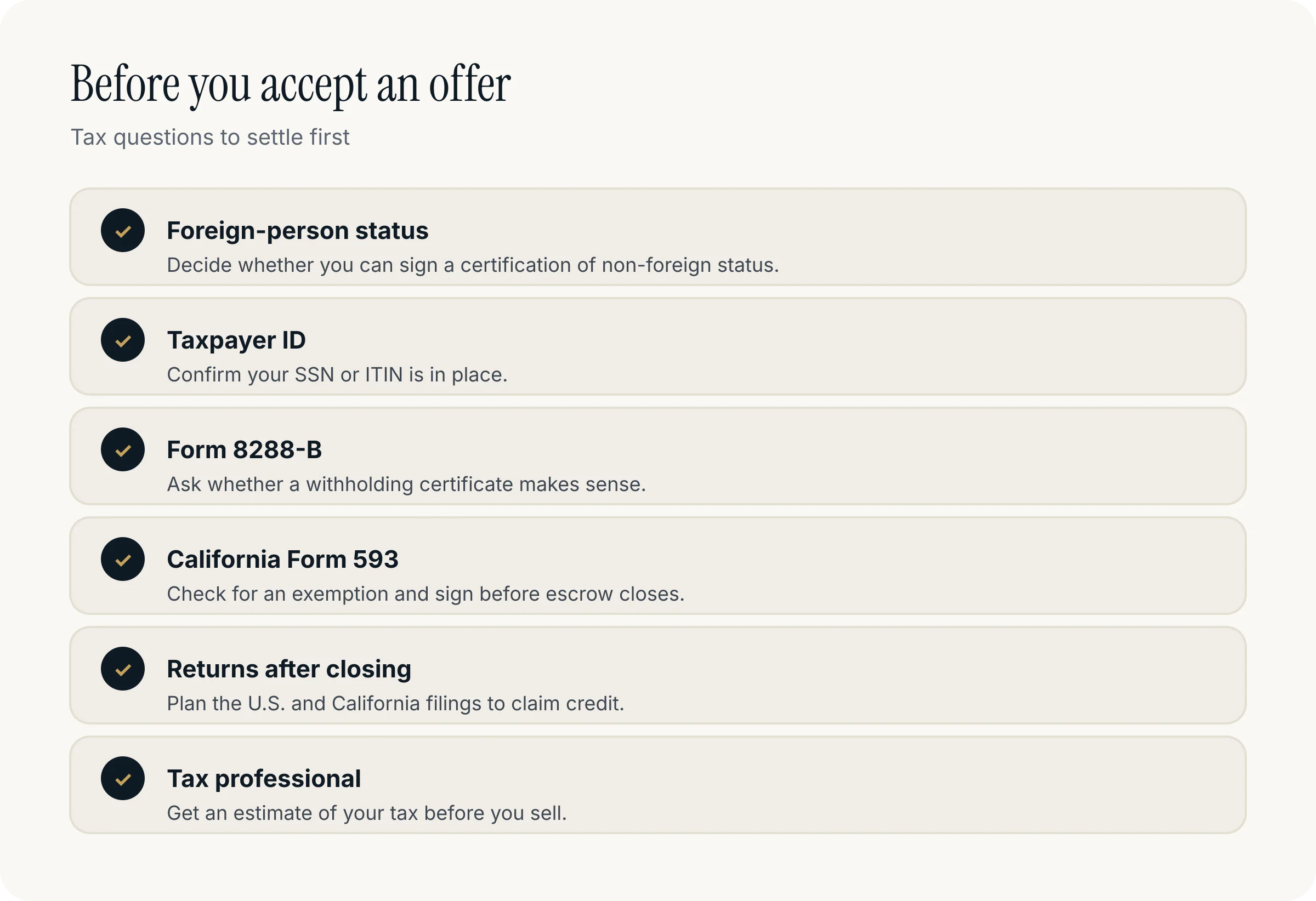
- Decide whether you are a “foreign person” for FIRPTA purposes, or whether you can sign a certification of non-foreign status.
- Find out whether your taxpayer ID (SSN or ITIN) is in place, since a missing number blocks credits and refunds.
- Ask whether a Form 8288-B withholding certificate makes sense and whether the buyer or you will file it.
- Check whether a California Form 593 exemption applies, and have it signed before escrow closes.
- Plan to file a U.S. return and a California return after closing to claim credit for the amounts withheld.
- Ask a tax professional to estimate your tax so you know what to expect.
Sellers without a tax advisor can talk to TaxDen in Concord (taxden.com). This article is general information, not tax advice. Talk to a CPA or tax advisor before you sell.
When you are ready to see how a cash sale compares, our how it works page lays out the steps. Here is what to expect from Sell Quick California:
We make a cash offer within 24 hours.
We buy houses as-is; the seller makes no repairs.
We pay all closing costs, including escrow, title and transfer fees, and charge no commission.
Call (925) 854-5040 or tell us about the house through our offer form or contact page, and we’ll send a no-obligation cash offer.