
What does a quitclaim deed California homeowners sign actually do? It transfers only the interest the signer holds on the day of signing, with no warranties, so it can change who is on title but it can’t fix a mortgage, a tax bill or a title problem.
What a quitclaim deed does and doesn’t do
A quitclaim deed hands over whatever interest the person signing (the grantor) owns at that moment. It does not promise the grantor owns anything, and it does not pass title the grantor acquires later.
The Board of Equalization (BOE) describes a quitclaim as a deed that transfers only the interest the grantor has when the conveyance is signed. It adds that there are no implied warranties with this type of deed. If the grantor owns no title, the deed conveys nothing.
That narrow design explains both its uses and its limits. The BOE says it is often used in divorces, when one spouse gives up any possible community property interest, and to clear a “cloud on title.” It is a quick way to change names on title. It is a poor tool for almost anything else.
Grant deed vs quitclaim: the real difference
A grant deed carries implied promises under California law; a quitclaim carries none. Both can be used to gift or transfer property, so the choice mostly comes down to how much protection the person receiving the property needs.
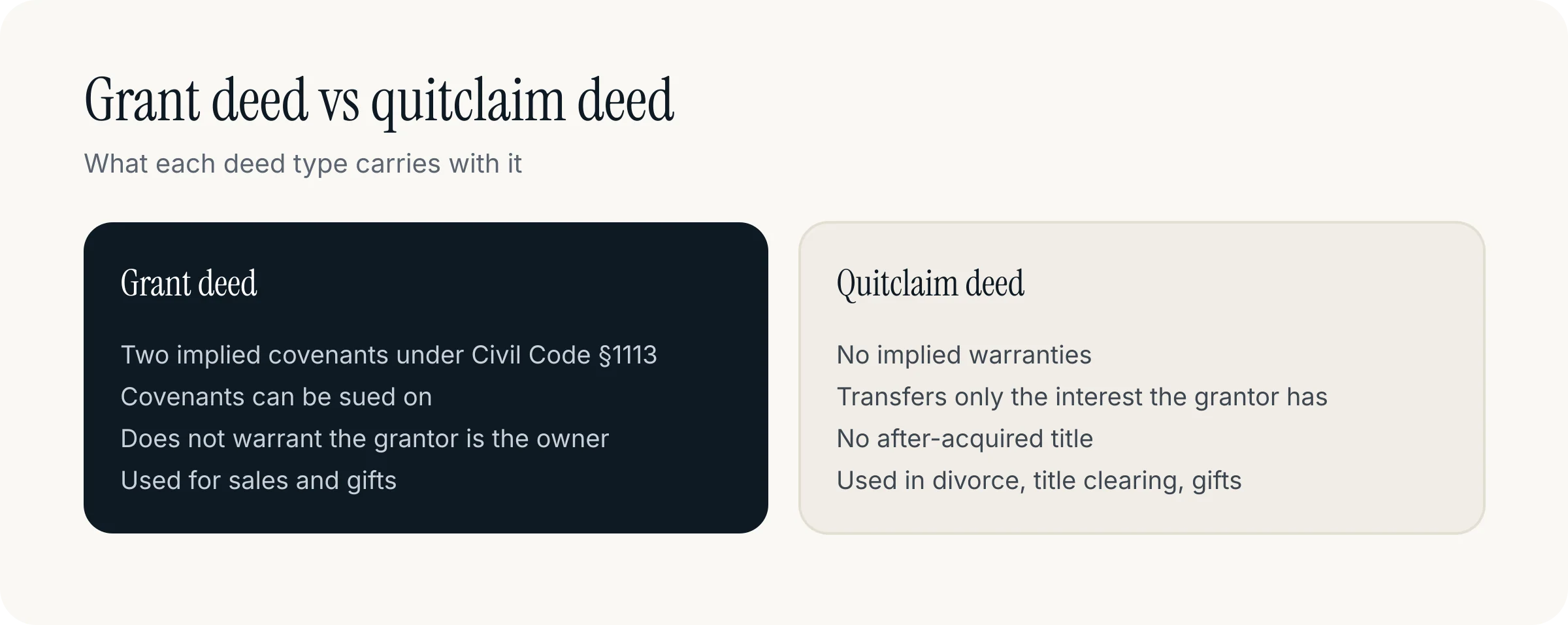
Under Civil Code §1113, the word “grant” implies two covenants. The grantor has not already conveyed the same estate to someone else, and the estate is free from encumbrances the grantor created or allowed. Those covenants can be sued on as if they were written into the deed.
The Department of Real Estate (DRE) points out that this does not mean the grantor warrants being the owner, or that the property has no other encumbrances. So a grant deed offers some protection, not complete protection.
| Feature | Grant deed | Quitclaim deed |
|---|---|---|
| Implied covenants | Two, under Civil Code §1113 | None |
| What it transfers | The estate, with those covenants attached | Only the interest the grantor has when signing |
| After-acquired title | Covered by the covenants in some situations | Not conveyed |
| Common uses | Sales, gifts | Divorce, clearing a cloud on title, gifts |
| Gifts | Allowed | Allowed |
Remove name from deed California: title is not the loan
A quitclaim can take a name off the deed, but it does not take that person off the mortgage. Title and the loan are two separate things, and only the lender can change who owes the debt.
Nolo notes that a quitclaim deed doesn’t relieve the person transferring ownership from the mortgage, if there is one. The DRE’s foreclosure guide says dissolution of a marriage does not automatically erase either spouse’s name from the loan, and that lenders are unlikely to voluntarily “remove” one spouse before a foreclosure sale.
Removing a borrower usually means a refinance or a lender-approved loan assumption. The mortgage servicer makes that decision, not the county recorder.
The due-on-sale pitfall
Congress made due-on-sale clauses enforceable nationwide in the Garn-St Germain Act of 1982. The Act has exceptions, including certain transfers involving a borrower’s spouse or children and transfers resulting from a dissolution decree. Do not assume a gift to a sibling or grandchild is protected; a federal agency noted that commenters asked for that coverage, which is not the same as having it. Ask the servicer before recording.
When a quitclaim deed helps
A quitclaim works best when everyone agrees, no one needs warranties, and the goal is only to change or clear names on title. The BOE lists divorce and clearing a cloud on title as typical uses.
- Divorce: one spouse gives up a possible community property interest, ideally as part of a written agreement or judgment.
- Clearing a cloud on title: someone who might claim an interest signs it over so the record is clean.
- Family gifts: a property gift can be made with a grant deed form or a quitclaim form, and the tax side matters more than the form.
Even in these cases, the deed should match the rest of the paperwork. A divorce judgment, a refinance and a deed should all tell the same story. If a deed is missing and you need to sell, the better starting point is our guide to selling a house without the deed.
When a quitclaim deed backfires: tax and spouse traps
Adding or removing a name can change the property tax bill, trigger a gift tax filing, or fail to do what spouses intended. Check these three areas before anyone signs.
Property tax reassessment
A change in ownership sets a new base year value for the affected portion of the property, unless an exclusion applies, so adding or removing a name can trigger reassessment. Transfers between spouses are not reassessed. Refinancing generally isn’t either, unless someone is added to or removed from title, and then the owner carries the burden of proving the change was only for the refinance.
Parent-to-child transfers can qualify for an exclusion under Proposition 19, but the conditions are strict. The family home must have been the transferor’s principal residence, and the child must claim the homeowners’ exemption or disabled veterans’ exemption within one year. The exclusion is not available for transfers between siblings. The value limit is the factored base year value plus $1 million; market value above it is added to taxable value. The BOE’s first adjustment raised the figure by 2.26 percent to $1,022,600, so check the BOE for the current number. Our Prop 19 guide covers the details, and the BOE’s Prop 19 page has the claim forms.
Federal gift tax
A quitclaim to someone for no payment can be a gift. The IRS says the 2026 annual gift exclusion is $19,000, and gifts to one person above that amount (other than to a spouse) generally require Form 709.
Spouses and “express declarations”
Family Code §852 says a change between community and separate property is not valid unless made in writing by an express declaration that the adversely affected spouse makes, joins in, consents to or accepts. In one published case, neither the quitclaim nor the spousal acknowledgment said the character of the property was changing, so it did not do the job. Courts also presume undue influence when a transaction between spouses favors one of them, and one appellate court affirmed setting aside a quitclaim because the wife lacked full knowledge and did not understand its legal effect. Our page on selling when one spouse does not consent explains more.
Signing, recording and fees
The grantor signs in front of a notary public, and the deed is then recorded with the county recorder along with a change of ownership report. Costs vary by county, so call the recorder before you go.
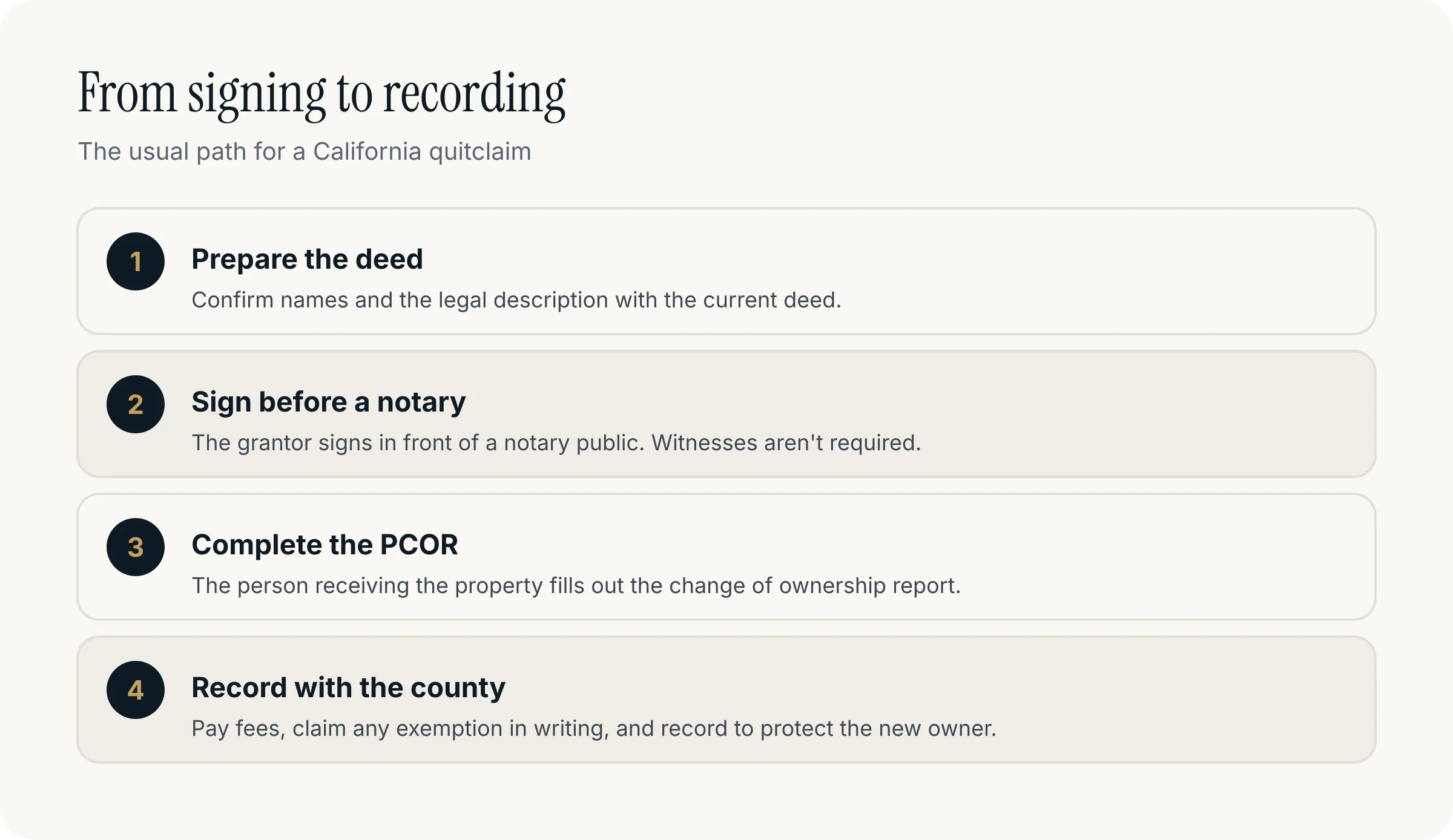
Nolo says witnesses aren’t required. The BOE says recording does not affect a deed’s validity but does protect the person receiving the property: if that person does not record and another document affecting title is recorded first, the first grantee is in jeopardy.
- Change of ownership report: the Preliminary Change of Ownership Report (PCOR) is required with the deed. Tulare County notes that failing to file it, or filing it incomplete, adds a $20 recording fee.
- State housing fee: $75 per recorded document, up to $225 per transaction, unless an exemption applies. Exemptions include documents recorded with a transfer subject to documentary transfer tax. Write the exemption on the first page or a cover sheet, or the fee is charged.
- Documentary transfer tax: many county schedules list $0.55 per $500, or $1.10 per $1,000. Certain transfers, such as gifts and transfers by reason of death, are exempt. Some cities add their own tax, so ask the recorder.
- Base recording fees: these differ by county. Sierra County’s 2026 schedule lists $15 for the first page and $3 for each additional page.
New notification rules in 2027
Under Government Code §27297.7, each county must set up a recorder notification program on or before January 1, 2027. The recorder then notifies the parties who signed a deed within 30 days of recording, and the board of supervisors may authorize an added fee. Details vary by county. Tulare County, for one, says it will require an Assessor’s Parcel Number on deeds to prepare for the program.
Quitclaim deeds and selling the house
A quitclaim deed is not a way to sell a house, and it does not clear debts attached to the property. It only moves whatever interest the signer has, so liens, loans and title defects stay with the property.
If the house has a tax lien, judgment lien or other title problem, a deed between family members will not remove it. Our guide to selling a house with liens or title problems explains the options.
If the owner owes more than the house is worth, a cash sale usually won’t work. When a seller owes more than the house is worth, or a reverse mortgage is close to the value, a short sale or an experienced listing agent is the better path; our sister company Investly handles those.
For houses with real equity, a cash sale is usually faster and simpler than a traditional listing, but it often brings less than a fully prepared listing. Sell Quick California only makes cash offers; we don’t list houses. Weigh the tradeoff against your timeline and the condition of the house.
What to do next
Before signing any deed, confirm who is on title, what is owed, and what the deed will do to your taxes. Then make sure the paperwork agrees with your divorce, family or estate plan.
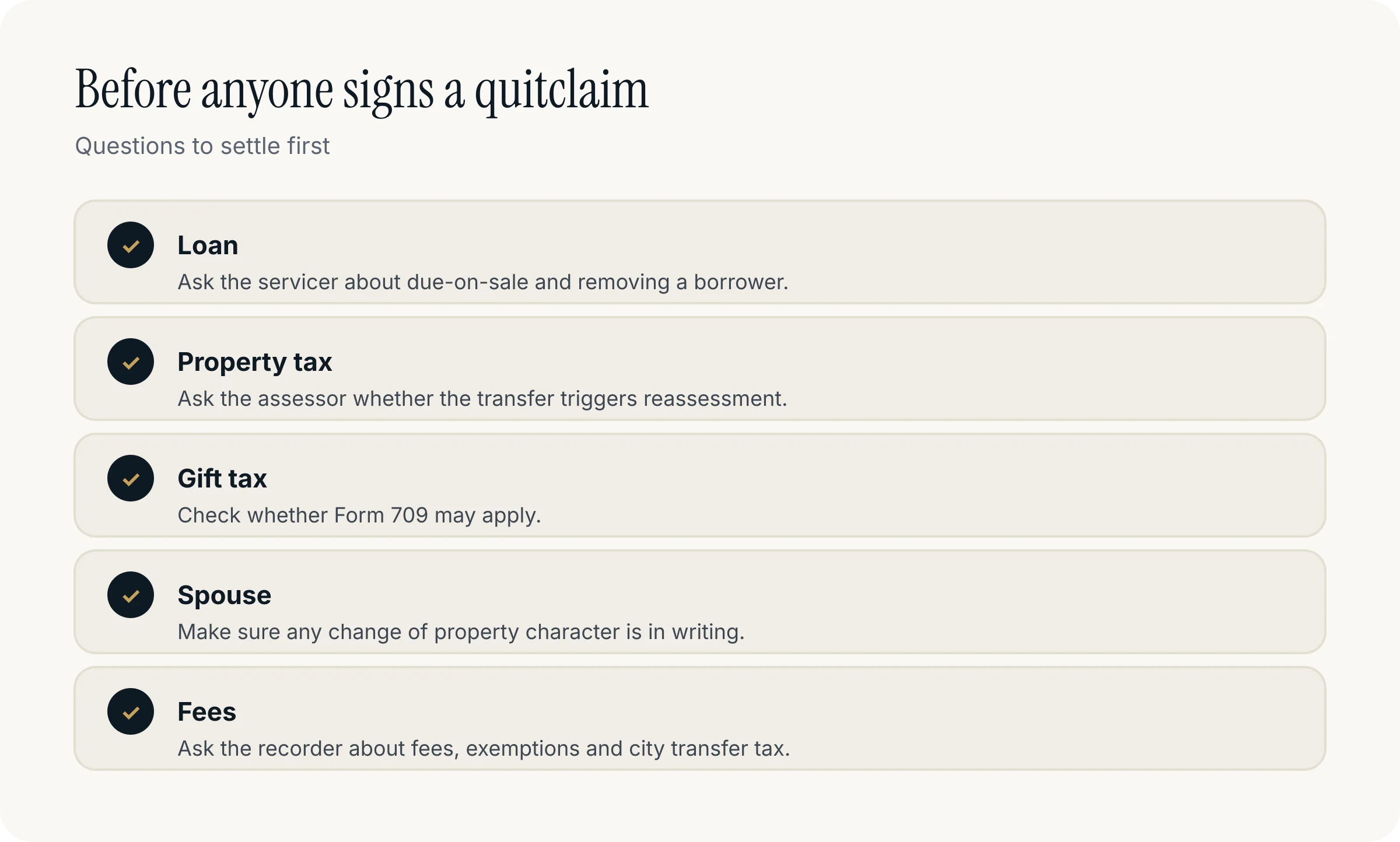
- Pull the current deed and the latest loan statement.
- Ask the mortgage servicer whether a transfer triggers the due-on-sale clause.
- Call the county assessor about reassessment and the county recorder about fees and exemptions.
- If gift value is involved, ask a tax professional about Form 709.
- Have a California attorney review any deed between spouses.
This article is general information, not legal advice. Talk to a California attorney about your situation.
If selling is the real goal, a cash offer is one option to compare with a listing.
We make a cash offer within 24 hours.
We buy houses as-is; the seller makes no repairs.
We pay all closing costs, including escrow, title and transfer fees, and charge no commission.
Call (925) 854-5040 or tell us about the house through our offer form or contact page, and we’ll send a no-obligation cash offer.